Friday, August 04, 2006

for Charlotte

He picked out the smallest bedroom on the second floor for his new quarters; it was shabby and dark, with no curtains and the ugliest yellow wallpaper he’d ever seen, but he’d lived in worse. At least it was well away from the attic workroom, and the double windows let in a cool breeze from the woodlot behind the house. That breeze was an important consideration, in St. Louis in August, when the night air clung like wet cotton, and a feather bed felt like a sweaty hand cupped around him.

Tired as he was after the restless night before, he got engrossed in the old London Physicians Monthly she’d given him and kept reading until long after dark, feeling vaguely decadent at the waste of lamp-oil. She’d marked the article on microorganisms for him to read, but he was more interested in the piece on treating nervous disorders. Having spent a year in an asylum, himself, he was grimly fascinated by the author’s theory that a sick mind was only a tired mind: like a machine, the brain could be overworked, and the best cure was complete rest. Trace had never seen a machine mend itself by sitting idle, and he’d only been cured by isolation and rest because he’d gotten smarter about not telling people when he could see things they couldn’t.

The small clock on the mantle chimed midnight, rousing him out of his light doze. He was so drowsy his head felt swimmy, but there was no need to be up at dawn to run down stray horses or get sleepy oxen moving, and he reckoned he’d best get used to her hours. Besides—the thought surfaced before he could dodge it—it had been five years since he’d tried to sleep in a room without Boz’s snoring.

He gave his head a shake and rolled onto his other side, vaguely upset in the stomach from all the rich food she was feeding him. Or maybe it was the wallpaper, he thought, glancing up from the pale cream page to the hideous yellow walls. He wasn’t in the habit of noticing decoration—didn't often stay in a room that had any, point of fact—but this wallpaper was singularly offensive. The color was bad enough, a dirty yellow shade that reminded him of a dust-storm on the horizon, but the pattern was worse. It seemed to seethe in the lamp-light at the corners of his eyes, making him feel vaguely fever-sick, or maybe morphine-sick.

He turned up the wick again, flipped back to the article he was supposed to be reading. It was interesting, but too full of unfamiliar terms for him to just skim it. He had to mentally parse every sentence in order to squeeze out the meaning. It seemed a Swiss named Lister had proven the existence of tiny creatures called “microorganisms,”—too small to see, but alive and aggressive—which attacked healthy body tissues, causing disease and putrescence. This was some different from the idea of spontaneous generation, which Trace had learned about in seminary. Spontaneous generation taught that maggots and putrescence sprang from the decaying matter itself. He’d always thought that made sense enough, seeing as how God had created the world out of nothing. But the idea of tiny, invisible creatures invading healthy flesh reminded him of ants swarming over a scorpion, or those bloodsuckers swarming the train. Nature tended to repeat the same patterns in different sizes, so maybe God had made microorganisms, too.

A whispering sound drew his gaze up from the page toward the dark eye of the window. The curtains were missing; even the hardware had been wrenched from the plaster. The wallpaper was stripped off in patches, too. Maybe someone had intended to redecorate this room and never got around to it. Trace wondered briefly how long Miss Fairweather had lived in this house and whether she had made any efforts to remodel it. It seemed unlike her to spend time decorating, especially since she did no entertaining. And yet she had the manners of a trained hostess. She was always unfailingly proper, even while insulting him. She didn’t wrap herself in frills and fripperies like the fashionable ladies he saw around St. Louis, but he’d seen her in very fine clothes on a couple of occasions, and even her plain work dresses were better-fitted and finer cloth than those of a shopgirl or farmwife.

She had money, obviously, had probably been born to it. Might even be minor English nobility. No doubt had been raised a proper lady… but that didn’t explain her education, her training in science. Trace had read of some medical schools back east starting to admit ladies, but Miss Fairweather was not much younger than he. Maybe the schools in England were more permissive. Maybe she’d had tutors.

Another scientist who supported the microorganism theory (he read) was a Frenchman named Pasteur. Some years ago he had boiled some meat broth in a glass jar, then bent the neck of the jar. This was supposed to prevent microorganisms in the air from getting into the broth, and it worked fine until Pasteur tilted the jar to let the broth into the neck of it. After that, the broth got rancid, which was supposed to prove that these tiny creatures were carried by air currents.

Appalling thought, really. Trace’s mouth curled in distaste, thinking of what he might be breathing in. As if to underscore the point, a cool gust of air touched the sweat on his arms and chest. He shivered lightly, thinking there must be a storm on the way.

The whispering came again, a faint and yet fleshy sound, like a like a hand dragged along the papered walls. Trace surfaced from his reading-doze and looked up.

Nothing stirred, inside or out. It was a very still night. In fact, he realized, there was no breeze coming in the window.

The room was stifling-hot, but his arms were tingling with gooseflesh, as if a cold breath had blown across his skin. It had been a while, he thought suddenly, since he’d taken the time to meditate. Maybe too long.

He sat up in bed, peering into the dark corners of the room, but there was nothing to see except shadows and the contorted pattern of the wallpaper. It seemed to writhe, like heat-visions on the Great Salt Flats, and most of the movement rippled close near the floor, as if something were crawling down low behind the paper. Something vaguely human-shaped, with long hair hanging over its face. Its shoulder dragged along the wall with a faint rasp and the occasional thump as it knocked past a bit of wainscoting.

“Uh, pardon me?” Trace said.

The crawling figure stopped, hunching in on itself, like a mouse caught on the pantry floor.

“I don’t mean t’interrupt, but could you maybe go do that somewhere else? It’s a mite disturbin.”

The figure resumed creeping as if it hadn’t heard. Trace lay back down with a snort, turned toward the window to find a cooler spot on the mattress, and went back to his article. But now he was aware of the noise he couldn’t shut it out. His ears tracked the slithering all the way down the wall, over the doorway and its trim work—ba-dump, ba-dump—behind the bureau, under the dressing-table, under the window—ba-dump, ba-dump—to the fireplace, where there was a pause just long enough to make him think it had stopped, before it resumed on the other side.

Trace sighed. Round and around all night would drive him crazy. By morning he’d be creeping along with it.

“Alright, you win,” he muttered, rolling off the edge of the bed. He collected his clothes from the chair, put his hat on his head, and took the lamp in his free hand. There was a whole row of bedrooms up and down the hall; surely one of them was unoccupied. “I reckon you were here first.”

Tuesday, July 25, 2006

everybody was kung-fu fighting

Last weekend was the big taiji tournament in Dallas. We drove down in a rented minivan--myself, my partner Tony, my sifu Sit, his wife Mary Ann, and our classmate Heather. Mike and Matt took a separate car and met us down there. I could go into a long exhaustive description of what it's like to be trapped in a van with four other people for ten hours, but frankly I don't want to relive it.

Just kidding. It went pretty smoothly. There were the predictable ego struggles and back-seat driving, and Mary and I were both a bit ill--she had food poisoning, I had cramps (isn't that inevitable?), but there were no accidents or flat tires and we didn't get lost. We got to Dallas in good time, checked into the nicest Best Western I'd ever seen, and then met up with Matt and Mike for a marvelous fish dinner. It was good to see Matt again; he's off at grad school in California. He's tall, whipcord-lean, intense, and talks really fast. He's twenty-five but will probably look eighteen until he's forty. He kept getting carded, everywhere we went.

Pappadeaux seafood restaurant was really marvelous, even if I was too low to fully enjoy it. The guys ordered raw oysters, which I didn't quite have the stomach for that night, and boudin sausage, which I did try and was very good. They also have a marvelous fish called "pontchartrain," which (purportedly--I haven't researched this independently, so don't quote me) comes from some lake in Louisiana with the same name, and is served with crabmeat and shrimp in a white-wine/butter sauce. WOW, is it good. They've got some similar dishes at Copeland's, the best Cajun-Creole restaurant in my neck of the woods, so I guess I'll have to patronize it more frequently.

Tony had a gift for me, in honor of my first tournament: a puzzle box he built with his own two hands, the kind where you have to slide the side panels and bottom in just the right combination before you can open the top, and then there's hidden compartments inside. It was very cool, beautifully made. Even cooler, inside the box was this lovely wicked little double-sided fighting dagger, the kind I've wanted for about fifteen years. Utterly useless unless you're a collector or an assassin, but Quinn and I loved it. Tony said it looked like me. All my close friends give me weaponry sooner or later. It's like a pact.

He had another gift for me at dinner, but I can't talk about that yet so we'll fast forward to the next morning, Friday, when we all trooped over to the adjacent hotel for the workshops.

I already had some inkling of how famous and respected Sit really was, but as in many specialized fields, he's only well-known in his venue. He sometimes complains that he's famous everywhere but Kansas City. Still, I felt a bit like tai chi royalty on Friday, because Sit's workshops were packed. We later learned he had been the top draw at that tournament, with nearly 1/3 of the workshop attendees signing up for his classes.

I attended his first workshop, "Tai Chi Secrets," and listened to him say the same old things he says every freakin' Wednesday, but for some reason it sounded fresh and more poignant, and the crowd was enthralled. He loves to teach and loves to have an audience, and he can be so charming and funny when he's in that environment. It also doesn't hurt that he's a genuine master of his art. He always makes a point of using the biggest guys for demos and putting them on the floor before they can blink.

It was tremendous fun. The expressions of astonishment on his volunteers when they get bent into pretzels are priceless. He never hurts anybody, that's the impressive thing. His art is all about softness and subtlety--he has this whole theory about how aggressive, hard movements transmit "information" to the nerves and brain of your opponent, so by responding softly and gently, you give them no information to fight against. This is a marked contrast to some of the hard-style guys who are all about mowing you over. Late Friday night, Tony and Mike took a workshop with a guy named John Wang who, though "very nice and funny," left vicious bruises on their arms. Wang claims he "feels uncomfortable" if he goes for more than a few days without feeling pain. "If you ever have to fight a gang," he said, "take the biggest guy right away and throw him down on the ground and bust his skull open. Then put a piece of his brain in your teeth and smile. Then you won't have to fight anymore."

I can just see myself using that in a story some day.

Needless to say, Sit's method is a bit different. I've had him put me on the floor plenty of times, and you never feel it coming. He doesn't grip tight. He doesn't even move all that fast. He's just so damned efficient. In workshops he invites the biggest guy to grip his shoulders and then pushes the volunteer's hands off with one finger. "Here it comes," Sit says. "One--two--three--" and the hands are off and the big guy is left standing there gaping. One muscle-head (there's one in every group) was making noises about how all that soft stuff doesn't work "if you do this," so Sit calls him out and went to work on him. The guy broke the pattern, tried to get cute by twisting out of the grip, and Sit goes, "Oh, you asking for trouble, now," and puts the moron in a headlock. In about ten seconds he had the muscle-head's nose pressed to the floor.

I vowed to myself then and there that I would train every freakin' day for the next year and make myself a worthy representative of such a cool master. I had several people come up to me later, and ask me about him and try to persuade me to persuade him to come do a seminar at their schools. Which would be way cool, if he could make a profit at it. It makes me sad to think how his weekly class has shrunk in the last year, what with people moving away and leaving for college. We now have more women than men in our kung-fu class, which is not good for business, alas--sends the wrong image. I'm going to have to get really good and start recruiting.

But I'm getting ahead of myself. Saturday was the forms competition. I didn't totally embarrass myself, but it wasn't my finest day. I was slightly crampy and more than a little high on Motrin Sinus, so I was simultaneously wired, limp, and light-headed from low blood pressure. The upside was that I was too physically drained to feel much anxiety. My empty-hand form sucked and my shoes were highly incompatible with the carpet so I almost fell on my face coming out of a leap, but I was feeling no pain.

Final score: I won two silver medals and a bronze in forms competition. That sounds pretty good unless you know that I was second out of two and third of three competitors in my division.

Oh well. I hadn't expected miracles. I had never done a major competition like this, and I knew I was unprepared, what with the divorce and the other upheavals this year. It means enough that I went and saw some other styles and got an idea of what the judges look for. Remember a couple weeks ago when I was complaining about how I had no idea of what was good? Now I do. It gives me something to work toward.

And I didn't completely embarrass myself. My weapons scores were better than the empty-hand. Matt said my broadsword form looked good, "like you were born with a broadsword in your hand," which is a high compliment from a guy who doesn't hand them out lightly. My fan form was rather respectable--the final score was 9.2, I believe. I didn't win, but I got a number of compliments, and the girl who beat me ended up winning Grand Champion of the entire tournament, so I can't feel too badly about it. I'd rather have approval from my peers than a gold medal, any day.

Ironically, my sewing-fu was what got all the attention. My new white suit was a big hit with the women, who liked the shape, and men, who also liked the shape. Many people stopped to compliment it and ask what pattern I used. I'd made my own, of course, but I took down email addresses so I could pass along the base patterns I worked from. The photographer from Kung Fu Magazine took several shots of me performing the fan form so maybe I'll end up in the next issue.

Sit told me I should write an article for them, "How to Survive your First Tournament," ("always take two pairs of shoes--you don't know what the carpet will be like!"), and he's been hinting for some time that I might help him write some of his own articles; he's had a number published but he's never comfortable writing in English. I had thought to attend the "Writing About Martial Arts" workshop on Friday night, but it was too late and I was too tired, and forgive me if I tend to think I've got the writing thing mastered. I did attend a push-hands workshop by a big bear of a Chinese named Sam SF Chin; Tony and Mike had taken his classes before and thought highly of him. The workshop was a bit pedestrian, to my mind, but that might've been because it was the introductory class and I'm a tad more advanced. Still, I got the master's hands on me a couple of times, and he does have an impressive, light touch. His general attitude toward me seemed to be approving, as well--he could tell I got his drift.

His senior student (another Mike) took quite a shine to Tony and our classmate, Big Mike, and spent a lot of time in-between events, giving them pointers on push-hands technique. Sunday was the push-hands competition, as since I was done competing, I got to watch quite a lot of it. Two years ago I did not see the point of push-hands AT ALL, but now it's the most fascinating thing ever.

Push-hands is a bit like Sumo, only without the diapers and the opponents don't charge each other. They start out toeing a line, the backs of their right hands touching and their left hands on each other's elbows. You circle a few times to feel for your opponent's balance or lack thereof, and then try to shove him off his position. In restricted-step push hands, you just have to make him move his feet; in moving push-hands you try to push him out of a ring, hence the Sumo comparison. This may sound simple, but there's a lot of technique involved. You can't just tighten up and brace your legs; your opponent will push you sideways or pull you forward flat on your face. If he's stronger than you and he pushes suddenly, you turn aside and let him fall. If he tries to grab your arm and turn you, you either brace his turn against him or you slip his grip and reverse it. It's complicated and fast, and the irony is, the ultimate technique is to stay totally relaxed and not think too much: you just have to go limp and react.

Tony won silver in his weight class; Matt got bronze. Mike surprised us all and won gold in the heavyweights--and quite gracefully, I might add; we all agreed it was the best technique we'd seen from him. Sit said to me, "You going do push-hands next year?" and I go, "Hell, yeah!"

What can I say? It was a fascinating, exhausting, intense, exhilarating weekend. I had been prepped with all these dire warnings about tedium and pompous judges and interminable demos, but apparently (as Sit said) my added chi tipped the feng shui in the right direction, because everything moved along briskly and was quite entertaining. The Masters' demos at the opening ceremonies were very good, quick and to the point. The lion dances were energetic and fun. Our own presentation onstage went off without a hitch and met with enthusiastic applause. The judges were pompous and biased, this is true, but hell, where isn't that true? I've been dealing with the publishing and editing world too long to let that upset me. The cream will always rise to the top, is my experience. My performance was not exactly cream this time around, but give me time. Now I know where the bar is, I've got something to work toward.

Tuesday, July 18, 2006

sociopaths: a field guide

I'm no psychiatrist, but I generally consider myself a good judge of human character (who doesn't?) so it's particularly rough on my self-image when I err. I am not a devious person by nature, so it doesn't always dawn on me when other people are being deceitful. And there are plenty of people out there whose entire raison d'etre is to deceive. I think for some, the need to lie is so ingrained into their method of survival that they actually lose their ability to discern truth from fiction. And this is what makes them so dangerous--to themselves and others--as well as difficult to detect: they honestly believe what they're telling you, at least at the moment they're telling it.

So if you're in a relationship, business or personal, with a person who exhibits more than a couple of the following behaviors, do not pass Go, get the hell outta Dodge--but you might want to grab that $200 on your way out because it's likely the only compensation you'll ever see.
  1. Chronic liars are mostly easily spotted because they tell small lies, what you might call "white lies," for no obvious reason. They concoct elaborate fictions when telling the truth--or saying nothing--would be simpler. They may do this to a third party even if you're standing there and you know the truth. If you don't contradict them, they know you'll be complicit. If you become more intimate with this person, they will expect you to back up their lies. And they will lie to you. Don't kid yourself about that point.
  2. When you do catch them in a lie, depending on the severity, they will either deny it or use charm to get out of trouble. They may justify it, but they will more likely construct an even more complicated story to validate the perceived discrepancy. If they are absolutely forced to the wall, they may cave under and flagellate themselves: "You're right, I'm a horrible person, I don't know why you put up with me.... *sob*..." until you relent.
  3. They are cagey about numbers, particularly when it comes to money and time. You can't pin them down to a schedule. You never know quite where they are. You end up spending more of your money on joint projects/purchases and they're always going to "pay you back."
  4. They always seem to have money for fun things, but not for essentials. They always have enough money to buy presents, buy back your goodwill in a crisis.
  5. They can always sweet-talk others into doing things for them but they never seem to reciprocate; they have a bad back, or a damaged knee, or are committed elsewhere, or are just too busy.
  6. They give the impression of working harder than anybody but never have anything to show for it. Regular displays of martyrdom are essential.
  7. They are often gregarious, but never seem to have any close friends. They have a wide range of acquaintances that they keep at arm's length, because their behavior can't withstand extended close scrutiny. They may be two-faced, accusing others of being phony or dishonest.
  8. Paranoia is a bonus. A recount of their day will largely involve how somebody tried to screw them or they put the screws to someone else. Somebody is always out to get them. If there's one thing I learned in retail, it's that the guilty customer is quickest to go on the offensive.
  9. When anything goes wrong, it's someone else's fault. Probably yours.
  10. Nothing is ever wrong, ever. If there's a crisis, they'll take care of it. They can't tell you how or when, they just tell you not to worry about it, it's no big deal, they'll take care of it.
  11. They borrow things and never return them.
  12. They steal. And if caught, they tell you they only meant to borrow.
  13. They tell you little bits of the truth, like, "Oh, I placed a little $10 bet this week in the office pool, didn't I tell you?" and you say, "Oh, that's okay," when the fact is they lost a thousand on the big game last Sunday.
  14. They usually have addictions. Some more destructive than others. Some more obvious than others. The question here is, which came first? Did the lying develop to cover for the addiction or did the addiction develop to placate the guilt over lying? Or do they both have the same not-yet-understood root cause? Does it matter?
Bottom line, sociopaths USE people. Depending on their needs and the severity of their disconnection from reality, they may feed off your time, your money, your affection, or all of the above. For a while, you may get what you need out of the relationship, as well, and you may think you can maintain a balance, but sociopaths are vampiric in nature: they're selfish and single-minded. Once a sociopath finds a giver he takes and takes until the source is tapped out, or wises up and severs ties.

In print, most of this looks like simple immaturity, but what's acceptable in a five-year-old is not acceptable in an adult. Anyone over the age of five should have a basic grasp of fair play, for example telling the truth, paying back what you owe someone, sharing toys and dividing labor. For a grown-up to not have a grasp of these basic concepts.... well, it's mentally deficient.

Wednesday, July 12, 2006

English slurring

I met with my SP last weekend and we did some forms-practice, in preparation for the tournament (I did mention the tournament coming up, didn't I?). We video'd each other doing our forms. Last night I watched the DVD for the first time.

I SUCK BIG TIME. Which is distressing enough on its own, but what's worse is, I had no inkling of the ways in which I suck. Okay, I knew about the lax hands, but I had no idea of how much excess movement I was putting into everything--elbows flapping like chicken wings, ankles flopping like dead chicken necks, hips wiggling around like I'm in a hula competition.

Tai chi is supposed to be about efficiency: a minimum of strength and movement to get the job done. I've known this for a while. I thought that was what I was doing. Of course it's been a really really long time since I saw any footage of myself doing form. Sit's told me a couple of times in the last year that I was using "too much hand movement" and I thought I'd curbed that but apparently that was only the tip of the iceburg.

I called up my SP and said, "Why didn't you tell me I was lurching around like Johnny Depp in that lousy pirate sequal and with just as little purpose?" He said he didn't feel comfortable criticizing my form. And I go, "Look, buddy, who else is supposed to tell me these things?" since Sit rarely hands out individual instruction unless you ask for it and replace his roof first.

But what REALLY has me worried is that both my SP and my Sifu seem to think that my staff form is one of my weaker forms, and when I watched it on DVD I thought it was the most clean and precise of all. My SP says I don't have the body movement coordinated yet, but at least I'm not waving my limbs around like semaphore flags. Furthermore, everyone generally agrees that the fan form is my best form, but to me it looked pretty damn loose. So it's hard to know if what I see as incorrect, others see as simply my "style."

The irony of this is that I probably started getting floppy in my form because I've been doing more application this year. Because I'm generally smaller and lighter than my opponents I've developed the habit of putting a little English on my body movement: turning left slightly before turning right, feinting back before going forward, etc. In some movements that's appropriate but I suspect I apply it too universally, because Sit's always telling me, "Too much movement!"

So I could claim that the sloppiness in application has been spilling over into my form. But that assumes my form was clean to begin with, and I'm not that arrogant. My SP, trying to make me feel better, said that everybody's form degenerates over time, especially if you're not constantly practicing and checking yourself. It's like a kinetic game of "Gossip"--where the movement morphs a little with each repetition, until it's barely recognizable anymore.

I could also claim that the rounder, more advanced forms I've been learning over the last nine months have contributed to the breakdown in precision of the older, squarer forms. In college I had friends who went over to England for a year of study and came back with these clipped little pseudo-accents that took some months to fade. I could assume it's the same type of thing going on with my forms--I've adopted a new accent without realizing it.

So I don't know what's causing it, or what I should do to fix it. It deserves to be said that I'm primarily comparing myself to my sparring partner, who has a very clean, minimalist form, but who could stand to loosen up in application. He's a rock. I'm water. We need to meet somewhere in the middle.

A really big mirror would help. So would another three weeks of 24/7 practice time. After much hemming and hawing I registered as an Advanced competitor. Pretty ballsy, considering this is my first major competition (I've done two small local ones). The rules state that if you've had more than 4 years of training that makes you Advanced, but everyone knows which of the masters encourage their students to downgrade themselves in order to win more medals. I've been doing taiji since 1999, but I've only been with Sit since 2001, and I missed most of 2002 and a good chunk of 2004. That still totals out to at least four years, and I couldn't bring myself to lie.

Sigh. It's times like this when you really feel the size of your pond.

Monday, July 10, 2006

the Princess Leia look

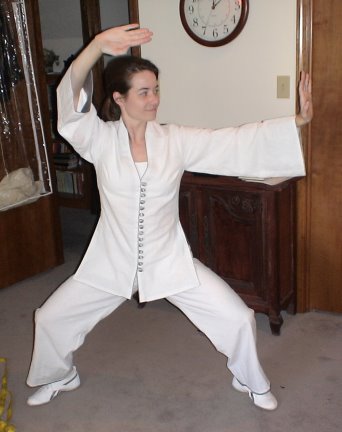
As promised, here are some pics of me in my new white uniform, posing in vaguely taiji-like stances. I really need to get those hands focused.

The uniform is a linen/cotton blend, very soft and lightweight, and the silver trim is silk dupioni. I will never understand why people complain about sewing with silk; in my experience it's a lot easier to negotiate with than say, a polyester of the same weight and weave. Charmeuse and satin are just plain difficult, regardless of fiber composition.


I had my sparring partner come by Saturday for his final fitting. Everything looks hunky-dory, especially the fit of the jacket. It's a revelation to a lot of people, myself included, that a uniform need not be oversized and billowing in order to allow mobility. There are tricks to fitting that are different from contemporary Western wear, especially in the sleeves, but you can get a nice clean tailored look and still be able to raise your arms. Which is why I don't understand why women's off-the-rack jackets are designed to hold one's arms rigidly at one's side. You can't even drive comfortably in them! But that's hardly the most heinous of fashion's crimes against mobility, so we won't dwell on it. I usually have to take in the waists of my jackets anyway, so I take the sleeve off at the same time and rotate the sleeve cap toward the back. Amazing how that works.

My SP's uniform is black. It has a dark gold facing on the inside, but it probably won't show much. I bought the buttons for it yesterday. Plan to do the hemming tonight. More pictures soon....

Thursday, July 06, 2006

from the sweatshop

Took Vera out for her first big run this weekend. (Having Monday and Tuesday off for Independence Day was a major break, and much appreciated.) I got my white taiji suit all finished, buttons on and everything. It fits perfectly, is quite cool, and looks pretty keen. I showed it to the gang last night, just hanging on the hanger, and Sit quipped, "Is that for me?" to which someone replied, "It's a bit low-cut for you." It's white with silver piping and buttons, and I hope to get pictures up this weekend, but don't hold me to that.

I also got my S.P.'s suit all put together, leaving the side seams unfinished so I could do the fitting. The collar fit pretty good, and the sleeve length was good, but the shoulders and body were much too wide. I can't figure that out: how did I manage to measure that far off? It's one of the mysteries of fitting that still don't make sense to me. I'm not even sure that my measurements were at fault, it's just something about the calculation of ease in a garment. Ah well--better too big than too small. It will be a fairly simple thing to rip out the sleeves and take in the excess.

The pants, now... that's scary. I haven't made as many pants, and I'm never sure how much ease to leave in the rise (crotch). Since these are kung-fu pants I was considering putting a gusset in the crotch, and I guess that can't go amiss even if it's not strictly necessary. What scares me is that I've got the rise too long as it currently is, and I don't know how much to take out. There has to be a compromise between comfort and fit. I've found that in kung-fu pants you want the crotch to fit fairly close, because if it hangs low the pants will catch across your thighs during kicks and that's what causes the rip-outs. But you don't want that center seam to bind, either, especially on your male clients.

It's a learning curve. And this attempt was better than the one I made last year. The collar fit well, at least, and the front placket and seams look good. I'll just nip and tuck a bit and it should be fine.

Oh, and Vera performed beautifully: strong, quiet, precise and smooth. I'm kind of incredulous to realize how I was making excuses for that old machine, telling myself I didn't need a new one because it wasn't that bad, but really I was making excuses out of fear: fear of change, fear of the cost. I kept putting up with the dropped stitches and the bobbin thread that was always coming loose and snarling (making more work for me to rip out and clean up), and the way the thread would pull out of the needle on the first upstroke, and I wouldn't even notice for several inches that it was only making holes, not stitching. It was infuriating and depressing, but I just gritted my teeth and kept on sewing, because it takes so much more inertia to leave what you know. Deep down I knew there were much better models available, better suited to my needs, carefully maintained models with precision gears and strong hard exteriors.

I guess the sewing angels were looking out for me. My new machine is so much more dependable and gratifying. Thank God I had the sense to recognize the bargain.

Monday, June 26, 2006

Vera

I'd wanted a new sewing machine for a while. I didn't quite need a new one, as I've been getting by well enough with an awl and some bailing wire, but my old machine was a stripped-down "learn to sew" display model that I bought at a steep markdown, so it was made of plastic and didn't have a lot of features.

I've shopped a bit for sewing machines over the past few years, and haven't been real impressed with what I saw. Machines for home sewers have been extensively computerized in the past decade, and like home computers, home sewing machines tend to come packed full of extras that the average user will never need; they just add up to more expense.

For myself, I knew I wanted a machine that could handle heavy-duty vinyl and duck canvas, but could also handle delicate silks. I wanted an extended table attachment and a knee-lift lever for the pressure foot. And I needed a model that had plenty of accessories available, so I could get additional feet as I needed them.

What I didn't want was a lot of computerized geegaws. All those fancy stitches look pretty impressive in the store, but I'm unimpressed with their quality--the stitch never looks as tidy as the little icon in the instruction manual. And seriously, who really needs to sew her name into her creations? A real designer will have custom clothing tags made.

But as with computers, I was having a hard time finding the mechanical features I wanted without going to a higher-end model that had a lot of electronic stuff I didn't need or want to pay for. Furthermore, I had a sort of secret yen for a machine with metal innards, which is pretty much impossible to find in a home-use machine these days. Up until the seventies, sewing machines were all metal--cases, gears, and all--and they weighed as much as a Buick. I imagine that the high cost of gas and shipping made this uneconomical for the manufacturers; besides, the average home sewer doesn't have a place to keep her machine set up permanently, and it's a real chore to lug a forty-pound machine out of the closet and onto the kitchen table. I remember my mom complaining about it, and I remember being afraid to drop it on my foot when I was a kid. Still, there's no denying that the metal gears are stronger and more durable. I may not be a carpenter or an auto mechanic but I like my tools to be built solid.

So I went looking at sewing machines this weekend. I may have mentioned that I've got a lot of sewing to do right now; my tai chi uniform is mostly done but I still have my sparring partner's to do, plus a weapons case that I should've finished up in January. And my machine, bless its little plastic heart, is protesting the strain. I think I messed up its timing while I was sewing on the vinyl, and its cams have not disengaged cleanly for some time now.

I took my sparring partner along for the ride. He's a craftsman too, albeit a woodworker, so he has a general eye for quality and a shared admiration for tools that are substantial and hard to move. Also, he has this naive idea that once I get a better machine, he can pay me to tailor his shirts and pants. I told him that was fine, provided he didn't want to wear them while they were still in style.

The first place we stopped at sold Brother machines, which were adequate, and in my price range ($400-$700), but were lacking in the weight-and-substance column. The next shop sold Janome machines, which I've always rather admired; they are well-made and moderately high-dollar. Still made of plastic, but it was a better grade of plastic and I liked the feel of their operation. The model I really admired was $1200, but there was another for about $890 that would have suited. It was electronic and had a lot of stitches I didn't need, but it was the lowest-end model that still had the table and knee-lift attachments I wanted. Why is that? Why the assumption that only a serious sewer is going to want the convenience of those features, and why does a "serious" sewer need all that extra crap?

It seems to me--it has always seemed to me--that a really serious artist/craftsman needs fewer tools than anybody. It's like in cooking: forget all that Pampered Chef crap--a chef's knife, a wooden spoon and a heat-resistant spatula are about all you need. But Americans have too much disposable income and too much ego and advertisers prey on that--they convince you that to be really serious about your chosen craft/hobby/vocation you've got to have every conceivable gadget ever made--as if these gadgets will miraculously imbue you with an encyclopedic knowledge of spices and the ability to gauge when the bread dough is perfectly elastic. You wish.

I had pretty much decided I wanted the Janome, and figured I could check out some online sources and find one at a steep discount. Nevertheless, I like to be thorough, and there is a newly-opened Pfaff store in town. Now, I dislike Pfaff as a general rule. Pfaffs are like BMW's or Mercedes: well-made but overpriced, and if they break you've got to take them back to the dealer. Significantly, they are marketed to the wives of men who drive BMW's and Mercedes. If you go into a Pfaff store you quickly realize that the machine is only incidental to the cult you're buying into. When you buy a Pfaff, you automatically get classes. Not on how to sew, but on how to run the machine. They offer retreats. There are a myriad of "exclusive" accessories and publications and patterns to buy. And none of it will make you a better sewer. None of it will teach you how to design a dress, or fit a pair of pants, or draft your own patterns. It's just designed to make you spend more money and coo over the cute-but-useless wall hangings of your peers. It's an expensive variation on the "Quick-Easy-Fun!/Do It Yourself!" cross-stitch starter kits you see in Wal-Mart.

Anyway. The lady in the Pfaff store was breathtakingly patronizing. There was a "retreat" in progress when we came in, and she didn't seem to have time to wait on me. She asked me immediately what kind of sewing I did, and then my price range. I already knew I didn't want to pay her prices, so I said, "Doesn't matter." She immediately took me to the bottom-barrel "starter machine," which was still $1400 on sale. But she didn't want me to touch it--oh no. She wanted to demo everything, and she put special emphasis on the miracle of their dual-track feeding system, which apparently justifies the extra grand in cost. Then she leapt right into the closing--told me about payment plans and how they'll accept old machines in trade.

My S.P. was smirking, and I was rolling my eyes, because frankly I was not impressed with that dual-track feeding, and I didn't like the vibration of the thing, and it was still made of plastic. So I got a brochure from the woman and we beat it for the door, but on the way we were distracted by the bright gleam of sunlight on--could it be? It was!--metal.

Beside the exit was a rack of traded-in, refurbished machines, and smack in the middle was a thirty-five-year-old Bernina, solid die-cast aluminum at a guess, in mint condition. Now, Bernina is another high-end name, and this was a high-end machine in its day. They were asking $500 for it, which is probably what the thing retailed for in 1978 (i.e. about two grand today), but it was the home-sewing equivalent of, say, a 1978 Mercedes. And it looked barely-used.

I made my S.P. drag it out of the shelf and onto a display table, since it weighed about eighty pounds, and I made the snippy lady go back in the storage room and dig out the accessories. I'm guessing this Bernina was bought as a gift for some 70's rich housewife who never used it any more than the 2006 rich housewives will use their new Pfaffs, because the equipment looked barely touched. There was a knee-lift, an extended table attachment (which came off to allow free-arm use), and about seven extra feet, some of which I don't even know how to use, yet. Fortunately, the instruction manual was tucked inside the case, so I can learn. The machine itself was fabulously smooth and quiet, ran as precisely as a watch, and all the dials and switches had a real positive feel to them, gliding cleanly from one setting to the next with no resistance, no sound, just a palpable thunk as the gear slid into place. The stitch-selector on top is a thin metal tongue that shifts in and out of gear teeth just like the stick shift in a car. It's got about thirty different stitches, including overlock and blind hemming. And it all closed up inside its own carrying case.

I bought it. I don't like racking up extra debt when I'm trying to pay everything down, but I look at this as an investment. And considering that I got what I wanted for about a third of what I was considering spending, I'd say it was a good value.

I think I'll call her Vera.

ADDENDUM: Curiously, one of this same model, the Bernina 930 Record, sold on eBay the same day I bought mine. Only it sold for a good deal more than I paid....

Monday, June 12, 2006

I feel like a reserve-choice for Prom

In case you were wondering, "End of the Line" is still sitting on the desk of a prominent editor, who has been dithering since January over whether to include it in a prestigious and well-paying new market. Their interest has been consistent but uncommitted; my story has run the gauntlet of first-readers and other underlings and is now camped out on the editor's desk, hoping they'll have time, space and money to buy it. They're hanging onto it, but they tell me they are hopelessly overbought and won't be ready to make a decision on EOTL until October or so.

Ergo I'm pretty much stuck, unable to submit it anywhere else while they've still got it. And they know they've got me stuck because of the damnable length of the thing (very few markets will take anything that long) and because nobody else pays as much as they do.

Just to demonstrate how conditioned we writers become to abuse, my primary response is gratitude: at least this editor keeps me informed on submission status. If I were actually writing/submitting/marketing right now I might be more annoyed, but for now I only shake my head and keep listening to Goth rock. There's more than enough crap in my personal life right now to keep me distracted, and maybe some of my competitors, with more self-respect or better prospects, will get tired of the wait and drop out. It'd sure be a nice paycheck at the end of the year.

Monday, May 15, 2006

so, how was your Mother's Day?

A co-worker told me this one:

"My sister has, like, the fiscal responsibility of a total moron, right? She had one payment left on her Cavalier, and she decides she has to be driving something cooler. So she goes to a used car dealership and buys a Corvette. Of course she's this young bimbo, has no idea what she's doing, ends up paying about $15 thousand more than the car is worth, right? So she drives that for two years, all the tires are bald because she can't afford the maintenance on it, then she starts dating this guy at Ford and figures she needs to upgrade again. But she's so upside-down in the car payments, her credit's so bad that she has to buy this totally overpriced, overloaded Ford Explorer just to roll over the payments. So now she's ten thousand in the hole.

"So she gets these checks from her credit card, right? And she buys two horses with them. Yeah. Pays $1100 for these two horses. The thing is, one of the horses is pregnant. So she figures, the one horse will have a baby, and she'll sell it, and recoup some money.

"The horses--one of them's staying with a friend of hers, has some land up by the airport. The other one, the pregnant one was staying at my parents' house. Now I guess when a horse is pregnant and it's getting close to time, you're supposed to not let them exercise and feed them this special diet and all that. But my parents didn't do that. My sister was supposed to come and check on this horse every day and take care of it, but she didn't. She hadn't been up there in a week. So my dad goes out to feed the horse on Saturday morning, and finds the horse had gone into labor overnight. But the baby was like a month past due, so it was too big, and during the delivery, something ruptured, and they both died.

"My dad went out there to feed the horse, and there's the horse dead, with this other horse half out of it, and blood and guts all over the place, because I guess the baby just tore everything up trying to be born.

"And of course nobody told me anything, I just called up my sister on Saturday and go, 'What time you going over to Mom's?' and she starts to cry! And I go, 'What's wrong?' and she's like, 'The horse is deaaaad!!!' and I'm like, 'Well, I'm sorry, but what's that got to do with me and dinner at Mom's?' and she goes, 'Well, can you come help us bury it?'

"And I go, 'No.' Just, 'No.' I said there's no way I'm getting anywhere near that big dead horse. Forget it. So my dad calls up the vet and says, Hey, I've got this dead horse, you know, what can I do? So the vet tells him, Well, how much property have you got, and you have to bury it so far from the property line, or else I guess there's this organization out in Topeka that you can call and they'll come out and pick up your dead horse. But my dad's like, that'll be Monday or Tuesday, and there's no way I'm leaving this dead horse in my barn.

"So I guess my sister called this friend of hers who's a construction worker, and they brought over the backhoe on Sunday and dug this hole and buried this horse. And then I'm the bad son, because I show up a three, like I said I would, and found out they'd already eaten. Because they had to fix dinner 'while the guys were there working.' So I get there and all the burgers are cold because I didn't come help bury the dead horse."

Thursday, May 04, 2006

on bread

As some of you know, I'm generally a low-carb proponent. However this should not be construed to mean that I don't eat bread or I put Splenda in everything. No. This is silly. Substituting one bad chemical for another is not going to get you anything but deprived and cranky.

No, generally speaking I'm opposed to the massive amounts of sugar, fruit juice, corn syrup and corn starch that goes in 95% of the prepacked processed foods found in the supermarket. I'm a proponent of eating real food: butter and meat and vegetables and WHOLE fruits, not juice cocktails, thank you very much. I think we eat too much white flour and corn in this country, and I will admit to a weakness for tortilla chips, but I couldn't tell you the last time I ate a slice of Wonder Bread.

With that disclaimer in place, I was recently introduced to the product of a wonderful Kansas bakery called Wheatfield's that specializes in "naturally leavened" breads. Their ciabatta is marvellous--chewy and crispy and holey, with just enough flavor of its own but not enough to overwhelm the slathering of butter which is of course the entire reason for eating bread. Right?

Anyhoo, I got curious about the use of "natural leavening" as opposed to commercial yeast in bread making. My mother's considered a champion bread baker, but she tends to prefer the soft white "tea bread" styles--dense and slightly sticky, enriched with milk and sugar. Myself, I'd rather have something a little sour, a little richer, and salty rather than sweet. So I went looking for basic methods on how to make your own "natural leavening"--what is generally referred to as a sourdough starter.

This dude's essay is particularly instructive and amusing:
The novel thing about sourdough baking is that it requires that you keep something alive in your fridge. I think of my starter as a pet, kept and fed so that Sandra and I will have all the bread we need. Sourdough "starter" is a batter of flour and water, filled with living yeast and bacteria.

Blend a cup of warm water and a cup of flour, and pour it into the jar. That's the whole recipe! I use plain, unbleached bread flour most of the time, but I've had good results with all-purpose and whole-wheat flour, too.

You should keep the starter in a warm place; 70-80 degrees Farenheit is perfect. This allows the yeast already present in the flour (and in the air) to grow rapidly. Temperatures hotter than 100 degrees or so will kill it. You can take comfort from the fact that almost nothing else will do so.

Within three or four days (it can take longer, a week or more, and it can happen more quickly) you should start getting lots of bubbles throughought, and a pleasant sour or beery smell. The starter may start to puff up, too. This is good. Here's the gist: When your starter develops a bubbly froth, it is done. You have succeeded. If this sounds brain-dead simple, that's because it is. People who didn't believe the Earth was round did this for millenia.

Yes, and their digestive systems were probably happier. If you don't believe me, come hang out in the restrooms about 1 p.m. when all the fat women in my office are purging their Lean Cuisine meals of the day before. That's what corn starch will do for you, friends.

So I'm thinking of baking bread again. Not like my mom does it, but like the ancient Jews did. Starting with the yeast and bacteria off my own hands. That seems appropriate, somehow.

Wednesday, May 03, 2006

terrible, horrible, no good very bad morning

I went to sleep with gum in my mouth and now there's gum in my hair and when I got out of bed this morning I tripped on the skateboard and by mistake I dropped my sweater in the sink while the water was running and I could tell it was going to be a terrible, horrible, no good, very bad day.
--from, Alexander and the Terrible, Horrible, No Good, Very Bad Day, by Judith Viorst.


I dawdled too long this morning because it was rainy and dark, and I'd left the windows of my car rolled down a bit so my seat was wet all along one side, and I changed bags because it was Wednesday and I have tai chi tonight so I packed everything into my gym bag but forgot to get my security passcard out of the front of my messenger bag, so I couldn't get into the building via the stairwell as usual and had the use the front door and the elevator like a tourist.

When I absentmindedly went into the stairwell with my breakfast in hand and realized I still didn't have a passcard and was trapped until some kind denizen came down from the fourth floor, I found myself thinking of Alexander. That was my brother's favorite book when we were kids. There was a time when I could recite the whole thing from memory, but unfortunately such useful brain cells have been overwritten with Social Security numbers and PIN's, bill-due dates and bank balances. I found myself smiling to think of Alexander's petty little problems and how they seem silly to us as adults, but it is nevertheless the little things that drive us nuts. Like a forgotten passcard. Or the cell phone battery running out of juice. Or having to make a detour for gas when you're already late.

Despite the rocky morning, I think it's going to be a good day. We really needed the rain around here, the weather is cool and exhilarating, and I have good hair despite the moisture (that's the good thing about having long straight blunt-cut hair: it looks pretty much the same regardless of atmospheric conditions). I had half a brownie leftover from yesterday so I ate that with breakfast. And I'm wearing my cowgirl boots because my knee is so much better, and a pink shirt and jeans because I am a Tough Chick. And I did my meditation last night like a good little student and I have tai chi class tonight.

Yes, I think it will be a good day.

Thursday, April 20, 2006

on fighting

I'm pretty jazzed about taiji lately. Of course I mentioned that Sit started me on this new training, but I can't really talk about that in detail. Not that it's a Forbidden Topic punishable by death or anything. We kind of expect kung fu masters to have secrets they only impart to their inside students, right? But the details have to stay private. I can't show it to anyone, and I'm not supposed to discuss my progress with anyone but Sit. This is to prevent jealousy and confusion between the students, because people inevitably progress at different rates.

As also mentioned, this training is generally not taught to married people, and Sit's never taught it to a female student. The bias against married people is partly due to the time commitment. It would take a pretty understanding spouse (or a writer?) to put up with the long silences behind closed doors. However there are a couple of guys in class now who are married and doing it, and Sit did offer it to me back before anyone knew I was moving out.

The exclusion of women is not a deliberate thing, it's just that Sit's never had a female student stick it out this far. I remember when I'd been doing kung fu about five or six months, and was working on the continuous cannon (Cannon Fist) form, and Tony remarked that women usually dropped out prior to that point. Then last summer Sit mentioned the sole female student he'd had finish the Internal form, which I've been working on since January. And I believe I'm the only woman in American to have learned the Six Elbows staff form, unless one of Sit's kung-fu brothers has another student somewhere else.

But even as exceptional as I am, I can see why women don't generally go in for advanced fighting training. We're afraid of getting hurt. I think it's partly out of interest in protecting our assets--our faces and breasts, which are very vulnerable. And about the same time we get those breasts, the boys get that growth spurt, and we learn very fast to be concilliators, rather than aggressors. Not that it does much good, considering rape statistics.

Generally, if women enroll in martial arts at all, they choose one of the flashy external styles, tae kwon do or karate or jujitsu, which can look damned impressive and tend to be marketed as useful for self-defense--but are, in my opinion, generally inappropriate against a larger, stronger opponent. Especially if you breeze through the katas and gain a brown belt in two years; you may learn the moves but that doesn't mean you can fight.

No, learning soft-style fighting is probably the best way for a woman to go, and I don't say that merely because it's the style I study. I've heard several big tough karate guys with big tough beer bellies remark on how those little soft-style guys seem to have so much more stamina. Problem is, learning soft-style takes time. And it's hard. And it's difficult to know when you're making progress. I've been with Sit about four years now, I've been doing kung fu for a little over three, and I've been in the advanced application class for about 18 months. Periodically, each time I move up in the ranks, I get this glacier of fear in my guts when I realize how much more I have to learn and how vulnerable I still am. I don't seem to have gotten that with this new promotion, but I could simply be in denial.

I generally give myself about 70-30 odds against the average rapist/attacker, depending on body type and discounting weapons imbalances. Knives don't particularly scare me, either; I handle them too much. I may not get away clean, but I'm not getting in a car while I'm still sensible and I'm not going down without taking an eye and a testicle, at least. However a lot of other women don't feel that way. I once saw a horrible newsmag story about a girl who was abducted from her home in the middle of the night, at gunpoint. The attacker forced her to drive her own car to a couple of ATM's, then to an abandoned field, where he raped and shot her.

WTF lady?! You were behind the wheel--you couldn't drive to a gas station, a police station, through a brick wall into a bank? You really think he's gonna shoot you while you're driving ninety? More like he'll be diving out the passenger door. Anything's better than doing what he tells you! But women still think if they cooperate they won't get hurt. That's kind of like assuming if we leave the terrorists alone they won't bother us.

But then again, there's no guarantee that I wouldn't freeze up in a crisis. I tend to think not, because I am generally pretty cool during emergencies, but you never know. That's part of the point of meditation in martial arts training, by the way. It trains your brain to override the fight-or-flight response, so you don't freeze up. That's why Sit tells us to practice with less emotion.

There are a couple of new guys in the Wednesday-night class: one who's a complete novice and the other who's been doing form for a number of years but never seemed to pursue the application side of things. They're both near my weight class, light and wiry, and somewhat beneath me in skill. I toss them around for a while, then when I get to feeling cocky I move on to Tony, who's built like a small tank. He's a lot harder to move. I can slop through it with the skinny guys, but Tony is not only very strong, he's very focused. He outweighs me by thirty pounds so I can't just use muscle and luck; I have to pay attention. That's an important test--if I can move somebody stronger than me it means I'm using intent(will) and technique, rather than muscle.

The only guys in class whom I have difficulty handling are John and Big Mike. John's just really hard. He did aikido for years so all his movements tend to be abrupt and jerky, rather than smooth. He's not much taller than I but he's pretty heavy. Not fat, just thick. Padded people are harder for me to work with on some of those delicate applications because my hands are smaller and I can't always get a grip. Eventually I'll learn to compensate but for now it's frustrating. Then there's Big Mike, who's really a gentle giant, and Sit says he has the fastest hands of any student he's ever had. Mike's got to be at least six-two or -three, because I tend to think I'm bigger than I am, ("You never think anybody's tall," Shara complained to me once) and I've gotten worse as I got more cocky about my fighting ability. Mike is tall enough that all my body mechanics get messed up when I try to work certain applications on him. That's okay, really, because if I were fighting a real opponent who was that tall I'd simply use a different application--focus on the ribs and knees instead of the head. Technique is a luxury anyway, in most combat situations, and Sit will be the first to tell you that. "If he attack you, hit him," he says. "If he try to grab you, hit him. If he throw a punch, hit him! Just keep hitting him until he go down."

Which is the most useful thing any woman will learn in any martial arts class.

Even aside from the physical limitations and the blocks in her own mind, the average woman just plain doesn't have time to devote to serious martial arts training. Who does, really? How many people do you know who really stick to their exercise regime? Hell, I'm no good at practicing on my own, either, I just happen to be athletically and mneumonically gifted. It drove my ex-husband nuts that I never seemed to practice but I kept making progress. (BTW, it's not that I NEVER practice, it's just I can rehearse moves in my head, such as while driving. Not the same, I know, but it goes a long way.)

What can I say? I'm an unusual specimen. And yet I am still a woman, and I never knew a woman who didn't have divided loyalties, whether it was kids or work or husband or church or God forbid, the soaps. Even the famous women artists and writers have a history of undermining themselves and their work for the sake of their men. Remember God's curse in Genesis?--"your desire will be for your husband, and he will rule over you." Who cares whether it was divine punishment or not--that's a damn accurate observation on the nature of womankind. I've done it myself, though not recently, and I know plenty of women who never outgrow it. Fortunately that's no longer a concern for me.

Now, with regard to Sit, I think there's a specific reason why women don't last long in his class. He's intimidating as hell, and much as I've always admired him, I've really only gotten comfortable around him in the last year. He is not friendly, unless he takes an interest in you, in which case he can turn suddenly and disturbingly blunt. He doesn't make small talk. He tends to lecture, even at the dinner table. He doesn't seem to care whether you show up to class or not, but if you're sloppy or unprepared, he'll roll his eyes and mutter under his breath. Plus his English is so strongly accented that you're never sure how much he understands or how much you're understanding of what he says.

This creates a barrier for women students because women have to feel accepted before they'll commit fully to a group. And women, alas, bond by talking. Nobody talks in class except Sit. Sit will walk into a conversation you're having with someone else and take it over. It took me months to learn everybody's names, and even now I don't know most people's last names or anything else about them. Most women can't cope with that. They need the support of relationships, even superficial ones, and I'll admit that I get pretty impatient with the older crowd in the Sunday tai chi class because they treat it like social hour. Yes, I felt very uncomfortable and isolated the first few months I was in kung-fu class, but it didn't matter. I was used to being the only girl in a troupe of boys. I wasn't looking for anybody to accept me, I was going for the workout and to learn.

As it turned out, that was exactly the right attitude to have. People have to prove themselves in Sit's class. Oh, he'll let anyone attend, he'll start the first form over and over again and repeat the same liturgy of drop-elbow/relax hip/suspend head-top until you're ready to scream, but he seldom dishes out individual attention. He won't spoon-feed you. He never corrects people one-on-one until they get to a certain level, at least have indicated that they've got a grasp of the basics and can learn by watching and listening. And he loses interest real quick if your attendance is sporadic.

Furthermore--and I think this keeps away students of both genders, but particularly women--there's no official ranking system in Chinese-American kung-fu, the way karate et ux have belts and such. Americans tend to think that they have to get regular recognition for something or it's not worth doing (my ex-father-in-law couldn't seem to grasp the fact that there were no belts in Sit's class). And Sit dumps all his students of all ranks into a single class, which is good for the beginning students in the long run but can be intimidating as hell to start out.

Sometimes, when I'm in a good mood, I'll make an effort to greet the new people, especially the women, and welcome them. But the fact is, the senior students are even less interested in the new people than Sit is. We know they're not going to be around long. In my case they knew I'd come from Sit's wife's class and I'd been coming to Sit's class for about a year before I started kung fu. They knew who I was so they were inclined to be polite, at least. I was intimidated but I tried not to put myself forward or act girly or self-deprecating. In fact I don't think I said a word in class for the first three months. Fortunately Tony took an early liking to me, because he had to student-teach me a lot and he knew I had focus and learned fast. Also it helped that there were only four or five of us at the time, and I'd only started about six months behind the core of that group, so Sit pushed me along very fast that year. Ironically, I think it also helped that I was the only woman, because I had to pair with a guy for practice, which forced them to get used to me and forced me to get used to a stronger partner, instead of dealing with a wimpy woman and her I'm-okay-you're-okay attitude. (Tony recently told his beginning students, "If I tell Holly to hit me, I'd better be prepared to block!") Once I got past that second-form milestone and started on the staff, they were ready to start taking me a bit more seriously.

I had a half-formed theory that perhaps the traditional Chinese masters didn't teach their secrets to women because women talk to much, but upon reflection it seems the sin of gab is not confined to gender. Tony was the first one who told me about the advanced meditation training, back when he was going through it. I hadn't even started kung fu at that point, and he prefaced the statement with, "I'm not supposed to tell you about this, but...." and then a two-hour recounting of the experience, including some the esoteric stuff which I am respectfully not revealing here.

What's funny is, Sit seems to have anticipated such a leak (admittedly Tony and I are pretty tight since the boys left, but we're not practicing together every day the way he and Matt were). When he offered to teach me the meditation he just dived in like I was supposed to already know all about it. He's also taking a more casual attitude toward teaching me the top-secret stuff than he did with his top male students--for them it was almost ritualized, but for me it was just another Wednesday night in the basement. Which is not to say that I'm being shortchanged in any way. Far from it. It's just that Sit knows how a student needs to be taught. Tony admits he probably expected and wanted more mystique and ritual surrounding that passing-down of secrets. I'm a far more pragmatic creature. I would've been rolling my eyes at any semblance of ritual, and Sit is more matter-of-fact with me than he is with some of the boys.

I think my seemingly nonreactive attitude frustrated him at first, as if I wasn't taking it seriously, but we came to an understanding about a year ago when he realized I wasn't going to flake out. It took me a while to understand that Sit's not really comfortable with intimacy, either, and I figure he found me as inscrutable as I did him. When he started talking to me about books and asking questions about writing I realized he was trying to bond. I quit being so insecure about my place in the class, I opened up a bit, and he started correcting and smacking me a lot more, which is the highest compliment the Chinese man can give.

I think he sees me as a bit of an experiment. I supposed I'd have to be, since I'm his first female student to come this far. Of course he knows I'm going through big changes in my life, and I've come a long way even without the advanced training. I think he wants to see what I'll turn into. I know I'm curious.

Tuesday, April 04, 2006

a very happy birthday

Birthday was grand. Had a lovely Italian dinner with Amber; roasted salmon and tortelloni in cream sauce, plus chocolate ganache cake to die for. Yum!

Even though it was my birthday, she got some gifts too: I finally handed over the two corsets she commissioned from me months ago. They turned out beautifully, if I do say so myself. One is sleek black satin and the other is bone-colored silk shantung, with a monochrome lace-and-velvet trim along the top. I finished the insides by hand so they look as clean and professional inside as out. She wants to do some self-portraits in them so I hope to add the photos to my portfolio sometime in the next decade.

She gave me a lovely box-framed butterfly specimen. I managed to get a rather crappy scan of it at work.


Sabine and I like it. In my new office in Mom & Dad's house (which was my old office, and before that, my sister's room) I have cleared off the top of my desk and arranged all of my Fairweather memorabilia: antique bottles, a model human skull, some rusty skeleton keys, and a sepia-toned picture of a distinguished and forbidding-looking man who's standing in for Sabine's father. I hung the butterfly on the wall beside the desk, between a naturalist illustration of a vampire bat, and a sketch of a brain dissection from the late 18th century. It's cool.

It's also rather symbolic. A couple people asked me if I felt older, and the truth is I feel younger. I know I'm entering a new phase in my life, and I feel lighter, full of possibilities. I haven't felt like this since I graduated college at the ripe old age of 26, but I always love the sensation. I've come out of my cocoon this month. Wings are still wet, maybe, but if I can be really corny with a clich&eacute, I feel poised for flight.

Monday, March 20, 2006

keep the fellowship to yourself

When my parents told me I could stay with them, one of the conditions they made was that I had to attend church with them "at least" once a week. This is a little tricky, seeing as how I have tai chi class on Wednesdays and Sundays. But I can make the Sunday evening service. I figure it's a small price to pay for nearly-free room and board, and a minimum of questions about where I go and whom I see.

I've been to two services now. Mom and Dad are getting a kick out of introducing me to their friends. It's kind of a novelty, knowing my parents now have friends, and like me they tend to collect people of many different ages. They're all very nice people, generally smart and interesting, but of course they all live in a world far removed from mine. When I'm in that church I feel rather like an anthropologist among a primitive tribe, or one of those Victorian ladies touring the asylum. None of it seems real, with all the laughing and hugging and gushing and praise-Jesus-ing. I guess they would feel just as disconnected if they were to attend one of my tai chi classes or a party. At least I can manage to be amused at it. They would be appalled.

It's all in the word choice, you see. At the church it's "Praise God," or "it's His will." In class it's "must be your karma," or "you've got bad chi." Of course I roll my eyes, as well, when Heather or Mike start harping on energy and chi and holistic healing. It's just kind of amusing, to me, to hear how these two groups keep groping after the same metaphors, the same explanations for the inexplicable, and yet would be so totally hostile to each other just because of the vocabulary.

Of course I'm as ecumenical as they come, but I suspect even I will have to draw a line in the sand, eventually. Mom likes to make little digs at Buddhism and feng shui and the Chinese belief structure, as if she has the slightest knowledge about any of it. I don't embrace any of it, but I respect it, and I respect my teacher (who's about as much a Buddhist as I am a Christian), and I really can't stand hearing people pontificate on things they don't understand. Or those who think it's okay to embrace racist models just because it's done in Christian love.

Last night this old lady was delivering the sermon. She's a decent speaker, often funny, but her points are too broad and dependent upon shaky warrants to really hold my attention. At one point she was talking about performing God's will instead of just paying lip-service, and she illustrated with a joke about a Chinese convert. This convert, when asked how he kept spreading the word in the face of opposition, replied, "First I get on my knees and talkee, talkee, talkee. And then I get up and walkee, walkee, walkee."

"Amen!" said the church, while I sat there feeling dirty and furious. I have NEVER heard Sit say "talkee" or "washee" or any of the other cliches attributed to pidgen Chinese-English. He doesn't even drop his articles. Yes, his pronunciation can be strange at times, and I sometimes misunderstand him because of the way he strings verbs together; Chinese verb structure is different and simpler than in English. But he certainly doesn't speak pidgin.

I never was exposed much to stereotypes or racism as a child. If my parents had any prejudices they hid them well. If anything they've gotten more closed-minded since they've been in that church, but I guess that'll happen to anyone who adopts an exclusionary attitude toward the world.

One other thing I've got to tell about last night. This was only my second trip and I've already got a stalker. I'd guess he's a bit younger than me, clearly the product of inbreeding. Thin red hair, rough florid complexion, bad teeth, slightly retarded, at least socially. He kept trying to make conversation, and touched me a couple of times, to get my attention when I was talking with other people.

On the drive home I told mom and dad to keep him away from me. They said, "Yeah, sorry, we figured he'd come sniffing around--just be sure you keep wearing your ring." But I know from experience that that type is not bright enough to take hints. If he lays a hand on me again I may very well hurt him--I can do a joint lock without anyone noticing, and I may just for the fun of it--just a smidgeon of karmic payback for my having to be there. I don't suffer fools or fanboys the way I used to.

Friday, March 17, 2006

on the road again

My daily commute has only gotten longer with my new living arrangements, but for the moment it's enough of a novelty that I'm still enjoying it. I get an interesting tour of the city every day: from farmland to the industrial districts, into the commercial zones, circumnavigate downtown and the spaghetti strainers on top of Bartle Hall, through another commercial zone and over a trainyard, into the suburbs, and finally to the fringes of the posh business district of Overland Park. Dad said I must feel like that guy in the commerical, who has to parachute off his front yard to get to his car at the bottom of the mountain. Yeah, something like that. Only base jumping would be faster and slightly less dangerous.

The first leg of my commute takes me along a lengthy rural two-lane highway, past a couple of major trucking distribution centers. So there are semis coming and going constantly; on high-wind days it can be a real adventure. Yesterday as I was driving in, a truck roared past me and somehow flung a decent-sized rock at my windshield. I saw it coming but couldn't do anything except duck. It glanced off and made a spiderweb crack the size of a quarter on the passenger side. Grr. So that's one more thing I'll have to get repaired. Let's hope it doesn't spread.

Thursday, March 02, 2006

heavy

Tai chi class was simply awesome last night. I'm kickin' butt and taking names. I've upped my working-application average to about 50%, which means I do it right about half the time. Granted, that's with a willing partner and at fairly low speed, but that's okay. Doing it right means you're not thinking about it, which means it's becoming automatic. From here it's a matter of building speed and accuracy. Sit is so pleased with me; he keeps taking me aside and showing me refinements, new ways to do it better. He's not saying "good enough," anymore, he's saying, "Yes, now add this."

I also experienced a curious tingling in my fingertips last night, especially while we were doing the block-and-slap "single whip" move. You're supposed to be very limp-armed during that slap, just crack your elbow and wrist forward like a whip. Stings like fire to get hit like that--it can leave welts. And for the first time I could feel the blood slinging into my fingertips when I swung. That's a very good sign; it means your chi is flowing freely. It adds a tremendous amount of power without relying on muscle tension, kind of like the impact of the water in a balloon. Today my fingers are still unusually red. Susan even noticed it. She gripped my hand and was amazed at how hot my fingers are.

Best of all, last night was just fun. There's some other heavy-duty stuff going on in my life right now, and I've been worn out with worry and stress and just plain being unsettled. I hate having my schedule disrupted; my husband teases me about being a creature of habit, but it's a simple fact--if you stick to a familiar routine, it frees up your mind for other stuff, creative and fun stuff.

So no matter what, I attend tai chi twice a week. If nothing else it's good exercise. And when it's good, it's transcendent. Last night there was a point when I looked around and realized I was exactly where I was supposed to be, doing exactly what I was meant to be doing. It was a moment of pure peace with the universe.

=======

"Don't worry," Sifu says,
"It turn out to be a good thing.
Maybe be real good."

Whirling storm calms
beneath the gong of a hand.
I sleep in the arms of hope.

They are loving and supportive;
they gave me the key.
But oh God, the books!

Tuesday, February 21, 2006

for the curious

From, A Short History of Technology: From the Earliest Times to A.D. 1900, by T.K. Derry and Trevor I. Williams, Dover Publications Inc., New York, 1993.
Although batteries were [...] an extremely convenient source of electricity for a great many purposes, the wide-spread use of electricity for heat, light, and power depended upon the development of mechanical methods of generation. The first mechanical generator was shown in Paris within a year of Faraday reading his classic paper to the Royal Society in 1831, by an instrument-maker, Hippolyte Pixii, in whose hand-turned generator the coils were fixed and the horseshoe magnet rotated. But before another year had passed, a machine was demonstrated at a Cambridge meeting of the British Association for the Advancement of Science in which the opposite principle, namely rotation of the coils relative to a fixed magnet, was utilized; this is now general practice. From 1834, at latest, rotating-coil generators were being made commercially in London.

The earliest generators produced alternating current[...]with a frequency depending upon the speed at which the machine was turned. This was looked upon as a most serious disadvantage--partly, at least, because all workers were accustomed tow orking with the direct current provided by batteries--but towards the end of the century it was realized that for large-scale use alternating current had decisive advantages over direct. For the time being, however, the problem of the conversion of alternating into direct current was solved by the invention of the mechanical commutator: a commutator designed by Ampere was fitted to an early generator made by Pixii.

There's a good deal more, such as the heating problems those early generators had, and the realization of self-exitation--that electromagnets could retain enough magnetism to start output from an electric generator, thus ending the need for an external battery or permanent magnets--being generally accepted by 1866. But none of that is really needed to underscore the point.

It should suffice to state that the ring-armature Gramme dynamo (generator) was introduced in 1870; it mostly ran on steam power, which goes to show that truth is stranger than fiction.

And for those desiring a more comprehensive timeline, here is a more succinct account of early electrical devises, appropriately enough, describing the Preconditions for Edison's Lamp.

Miss Sabine Fairweather kindly requests that the oh-so-educated gentlemen will refrain from impugning her research in the future, without the benefit of persuasive evidence. She dislikes wasting time in explaining herself.

Wednesday, February 15, 2006

karma

You didn't mean for it to happen. You've always sneered at people who spend all their time on the prowl, obsessing about that one true fit. Besides, you already have another in your life, who's always been faithful and comfortable. You're not even looking.

But sometimes it happens. A new love catches your eye and suddenly you realize what you were missing--what suddenly, heart-wrenchingly, you can no longer live without. A new love that cups your derriere lovingly, just the way you like it, and whispers how hot you are. The fit, the timing, everything is perfect, and you are more tempted than you've ever been before. You tell yourself that it's not right, that you're happy as you are, you can't afford this new commitment--what will you tell your spouse? But it's inevitable, really.

Sooner or later you're going to buy that new pair of jeans.

$24.99, baby. I don't even feel cheap.

Tuesday, February 14, 2006

name that tune: special anti-V-day edition

You ever toss and turn, you're lying awake
and thinkin about the one you love?
(I wouldn't think so)
You ever close your eyes, you're makin believe
you're holdin the one you're dreaming of?
(Well if you say so.)
It hurts so bad when you finally know
just how low low low low low she'll go.

======

Would you catch me if I fell
out of what I fell in?
don't be surprised if I collapse
down at your feet again
I don't want to run away from this
I know that I just don't need this

cause I cannot stand still
I can't be this unsturdy
this cannot be happening

=======

And you know you're gonna lie to you
in your own way

I know, know too well
know the chill
know she breaks
my siren

never was one
for a prissy girl
coquette
calling for an ambulance
reach high doesn't mean she's holy
just means she's got a cellular handy
almost brave
almost pregnant
almost in love

vanilla

=====

You're like an empty cup,
But I can't fill you up.
What planet are you on?
Not the same one I am from.
...
I don't get what you're trying to say -
What is wrong and what's okay.
So beat yourself up one more time
and trample on this fearless heart of mine.

=====

There'll be days when I stray
I may appear to be
impossibly out of reach
I give in to sin
because I like to practice what I preach

I’m not trying to say
I’ll have it all my way
I’m always willing to learn
When you’ve got something to teach
yes, and I'll make it all worthwhile
I'll make your heart smile.

=====

You know everybody's watching me
And what they see
Is me watching you
In the middle, time is creeping by
And I wonder why
You're so removed

And if you'd carry me tonight
I would be strong enough to fight
And when you're weak and can't go on
I'd be the bed you lay upon
And blue is blue
And so am I
Cause I want to be with you tonight
You're not the only one in need

Come on baby
life is just a net into which you dive
and I'm getting closer to you now.

If I love you will you run away?
and if you stay,
will I disappear?

======

Enlighten me, reveal my fate
Just cut these strings that hold me safe
You know my head
you know my gaze
you'd know my heart
if you knew your place
I'll walk straight down far as I can go

I follow you
you follow me
I don't know why you lie so clean
I'll break right through the irony

cure this wait
I hate this wait
I hate this wait

Monday, February 13, 2006

pimpin for my homies

My good buddy, and probably the closest thing I've got to a writing mentor, Rob Chilson, sent around a piece of mail today.

To whom it may concern:

My story, "Farmers in the Sky," is scheduled to appear in the May issue
of ANALOG, which will probably hit the stands in March.

Cheers--

Rob

And what's even cooler, I can say I got to read and edit it before it went to Stan Schmidt. I'm fairly sure Rob even took some of my advice, although by this point it's hard to say what advice was taken and what he already knew needed doing before he showed it to us.

Anyway, this story has the Holly Seal of Recommendation. If you like classic Heinlein and Alan Dean Foster, that kind of thing, you'll enjoy this. One of the rare examples of genuine speculative future-fiction I've seen in a while.

Thursday, February 09, 2006

surgical antiseptics

Carbolic acid, the stuff first used by Lister as an antiseptic in surgery, is also known as Phenol. According to Wikipedia:
Phenol has antiseptic properties, and was used by Sir Joseph Lister in his pioneering technique of antiseptic surgery, though the skin irritation caused by continual exposure to phenol eventually led to the substitution of aseptic (germ-free) techniques in surgery. It is one of the main components of the commercial antiseptic TCP.

Phenol has anesthetic properties, and is the active ingredient in some oral anesthetics such as Chloraseptic® spray.

Yum. Anyway, it appears hospitals have never really stopped using it, but found other applications for it. Wikipedia again:
Used as a "scrub" for pre-operative hand cleansing. Used in the form of a powder as an antiseptic baby powder, where it is dusted onto the belly button as it heals. Also used in mouthwashes and throat lozenges, where it has a painkilling effect as well as an antiseptic one.

According to a fictitious but well-researched account I read, surgeons stopped soaking their hands in acid about the same time rubber gloves came along, around 1885. Instead they scrub well and may rise with a mild phenol solution. Today most surgical procedures prevent infection by operation in a sterile environment, with metal instruments that can be sterilized. Any after-infections are treated with antibiotics and antiseptics.

Monday, January 30, 2006

varmints

Bout 6 o'clock tonight, I was sitting at the sewing machine, Scott was standing with the remote in his hand, programming the CD player to my direction. "Where'd you get this compilation?" he asks. "I had Tony make it for me," I said. "I asked him for some Gordon Lightfoot, and he--"

The power goes out, abruptly and completely, as if a switch had been flicked. I gasped as the room went dark, and distinctly heard a high-pitched voice squeal from the back yard, "It went off! Go, go!"

I leapt for the patio door, wrenched it open, and got out on the balcony in time to see three pre-teen girls leaping across the drainage ditch and running all-out across the vacant lot for the cul-de-sac behind us. Pink coat, gray sweatshirt, dark skin on the middle one. "Son of a bitch!" I exclaimed, incredulous. I grabbed my sweatshirt, stepped into my shoes, telling him what I'd seen and heard. "Call the rental office, now," I said, and dashed out the door, down to the ground floor and around back.

By the time I get down there, there's nothing to see except a couple of small footprints, in the mud next to the bushes. They're twisted on the balls of the feet, as if the feet had pivoted to run. I wedged in between the bushes and found the fuse box, with the main toggle switch for our building. None of the meters are running. I flipped up the breaker-cover: no lock or anything, heavily coated with cobwebs that had been recently disturbed. It was too dark to read the labels.

Scott's out on the balcony with a flashlight. "I called the office," he said. "They're calling KCP&L. You see anything?" "Drop me the flashlight," I told him.

He did, and I went back to the breaker-box, saw that yes, the switch had been flipped down from ON to OFF. I swept off the cobwebs and shoved it back up. Pop! Electricity makes such a hum, but you don't notice it until it's gone. The heat pump comes back on, and the lights upstairs.

"Holly," Scott calls, low, and I emerge from the bushes. He points. "Is that them?"

I peer through the bare trees and scrub brush. The girls are loitering down the hill, between two houses. I watch them walk up to the side of the duplex, behind the air conditioner, but one of them says something and they run away.

"Go catch 'em," Scott says.

"And do what?" I say. Not that I'm averse to the idea. I once shook the living daylights out of a twelve-year-old skater punk who thought it was cute to bounce herself off the hood of my car, in the movie theater parking lot.

"Tell 'em you've seen 'em. Scare 'em a bit."

Sounded good to me. I put up the hood of my sweatshirt and took off across the ditch, down the hill. I trotted around the side of the house to come on them at an angle. Sure enough, they emerged around the side of the house just as I was approaching it. They startled, but not guiltily. I am a smallish, nice-looking woman, after all. Not threatening.

"Which one of you is Maria?" I said, to get their attention.

They look at each other, confused. "None of us," the littlest one says, after a pause. She's maybe eight, Mediterranian-looking. The ten-year-old is black. The oldest is maybe twelve, with straight brown hair.

"Don't--" I say, and hold up the flashlight. They look at it, nervously. "--mess with the breaker boxes." Their faces slacken with surprise. "I saw you running away. I've seen your faces. I know where you live. If it happens again, I will send the police to find you." I make deliberate eye contact with each of them. Their eyes are looking misty and scared, none of the defiance I expected. "Do you understand?"

"Yes," they answer in unison.

"Now go home," I say, and stalk off up the hill.

I found out, shortly, that they'd turned off the power in at least three buildings. Pat the maintenance man came around not long after, and turned on the building next to us. I gave him a good scare when he saw me emerging out of the dusk. I told him what had happened, then repeated the story thirty minutes later when the P&L guy showed up.

It's kind of funny, now. I mean I can see how a kid would find it funny. Basically a harmless joke, just alarming. But it still disturbs me. Why do that to people you don't even know, just to cause trouble? I've always found that discourtesy, that disregard for other people's feelings, alarming. It's the root of all the world's problems, really.

But I did enjoy throwing my weight around. I was always in awe of the way my father could terrify the neighborhood kids without raising his voice. Apparently I inherited his technique.

Dang kids. I guess this means I am officially a grown-up, now.

Monday, January 16, 2006

Happy MLK day.

Minor point of interest: I got what you might call a "call-back" from that one publisher on End of the Line. The first reader's superior contacted me and asked for an .rtf copy, so she could forward it to the editorial board. So it's still afloat. I don't dare get too optimistic, but it sure would be nice to get paid professional rates for that thing--that would be a Godsend right now. And Raechel from Jinstu wrote to let me know that she'd sent out the reversion of rights last week. Poor kid. In a way I feel more sorry for her than I do for myself. Up until December it really sounded like Eggplant was doing well and poised for growth.

Tuesday, January 10, 2006

I liked the lady, all right monkey boy?

The Emperor of Ice-Cream, by Wallace Stevens

Call the roller of big cigars,
The muscular one, and bid him whip
In kitchen cups concupiscent curds.
Let the wenches dawdle in such dress
As they are used to wear, and let the boys
Bring flowers in last month's newspapers.
Let be be finale of seem.
The only emperor is the emperor of ice-cream.

Take from the dresser of deal,
Lacking the three glass knobs, that sheet
On which she embroidered fantails once
And spread it so as to cover her face.
If her horny feet protrude, they come
To show how cold she is, and dumb.
Let the lamp affix its beam.
The only emperor is the emperor of ice-cream.

Friday, January 06, 2006

two jokes

One--

On a certain blog belonging to two editors of a certain publisher, I found this:
A rabbi, a priest and a minister walk into a bar.

The bartender looks up and says, "What is this, a joke?"

Two--

I put a query package in the mail to said publisher today. Wocka wocka.

Thursday, January 05, 2006

waiting for the plot fairy

Writing is work, despite and still. No matter how good the buzz when it's going, no matter how strong the sense of pride when I finish something really cool, there's often a tremendous amount of inertia to overcome when I first sit down to start writing--or when I'm trying to force my butt into the chair so I can start writing. There are exceptions, of course, like when I get a really clear pivotal scene in mind, and then it becomes a matter of can't-get-to-the-keyboard fast enough.

But at the moment I'm kind of stuck on a couple of things. "Horseflesh" needs a couple of scenes in the middle ripped apart and knit together, and the same thing done with a couple of scenes at the end, and it's harder than hell for me to take apart a story that's already basically done and tinker with the structural underpinnings.

At least I have a pretty good idea what needs to be done, there. Curious Weather is, in some ways, in worse shape because I have all these cool intense scenes I want to get to at the end, and only a shaky idea how I'm going to construct a plot around them. Don't dare start on that until I know, because see above re: tearing out structural underpinnings after the veneer is already on.

I've been compulsively checking to my email and my usual round of blogs, almost hourly, the last couple of days. It's a procrastination technique, of course--I tell myself I'm looking for distraction, but I think in reality I'm hoping to find a mysterious piece of email from an anonymous benefactor, which will contain the missing connective bits of story, which I can then cut and paste into place and have to do nothing more strenuous than the editing.

Sigh.

Tuesday, January 03, 2006

barraccuda in a guppy bowl

Well, it's 2006. And Tuesday. And I'm back at work. Y'know, when you're a kid, the holidays are fun in part because it's a break in routine. But me being the creature of habit I am, after almost two full weeks at home, I'm actually glad to be back in the office.

Some random events and idle thoughts...
  1. Sit started me on the Big Daddy of forms last Sunday, the Six Elbows internal form, which is the basis of his kung fu style, the sacred hand-me-down of his teacher's teacher, blessed be his name, amen. This is heavy-duty stuff, because he doesn't teach this to just anybody. It's long and difficult and it's a sign that he takes me seriously and believes I will take it seriously, which means I may actually have to practice. He also offered to start teaching me some advanced meditation techniques, but I don't know that I'm ready for that kind of time commitment--it's not the kind of thing you can pick up and put down when convenient, and the last thing I want to do is flake out at this stage. He mentioned once that in 30-some-odd years he's only had one female student complete the internal form, and I don't think he's ever taught the meditation to a woman before. Serious, indeed. I don't know if I can handle that kind of pressure, I put enough on myself.

  2. The number-one source of self-induced pressure at the moment is, of course, Trace. I want to have it finished by summer, which is going to be pretty tough at my current rate of production, and considering that I may be even busier for the next few months. After I got the news that Jintsu was folding I quickly submitted End of the Line to a new venue and almost immediately ran afoul of one of those Barracudas-in-a-guppy-bowl, a/k/a the First Reader. He said the story was well-crafted and left indelible images, but said I needed to be careful with my dialect. I asked if he could be more specific. He said that nobody with Trace's education would EVER used an "unlettered" dialect. I countered with examples of how I do it every day, and trumped him with a news article about how politicians take elocution lessons to sound more "folksy." He responded with, "well, I'm an editor, and I strongly suggest you change it." I said, "Change what, exactly? If you could give me some examples I might know what the problem is." He said, "Forget it, you win." As if I was really being difficult for requesting a little specificity! I told Rob and Alison from my writer's group about it, and they told me to quit screwing around with rinky-dink e-publishers and make up a package for Tor. So that's what I did New Year's Day; I wrote a query letter and hashed out some summaries for the last five Trace stories. Which brings me to issue number five on my mind....

  3. I have a pretty good idea how the last half of the book is going to go, but I'm concerned about Mereck as the Big Bad, because he hasn't really made an onscreen appearance yet. He's been working well enough as this shadowy presence, kind of an abstract of evil or in Sabine's case, the devil who made her do it. He's going to get some development in Sabine's backstory, however, and in story number six, he's going to--needs to--appear front-and-center with a vengeance. And I'm not really sure how I'm going to do that, because the personality extremes are pretty well filled in the Sabine/Trace dynamic. And then AJ posted this Whedon quote, which kind of brought to the front of my mind how we've become accustomed to shades of gray in our good/evil dynamics, and what I wanted to do with this was create something much more black-and-white. Which means, Mereck has got to be BAD. But not Clive Barker-Rawhead Rex bad; at the moment I'm leaning toward the Victorian Old Scratch idea of the Devil: dapper and gentlemanly and seductive and inherently evil. Hating humanity, utterly consumed by his own selfishness and contempt for a good deed, but attractive even though you know he's going to destroy you--an extension of the theme of Trace's fascination/addiction/repulsion with regard to his powers and to Sabine. I'm thinking in terms of sexual deviancy, where you're aroused and nauseated at the same time. I'm thinking in terms of medieval torture devices. Poor Trace.